How Often Should You Wash a Ceramic Coated Car?
Wash a ceramic-coated car every two weeks. If you drive daily through a Michigan winter, tighten that to every seven to ten days. A garage-kept car driven most days can stretch to three or four weeks, and a stored weekend car needs roughly one wash a month.
A ceramic coating does not stop dirt from landing on your paint. It makes dirt release more easily once it does. That is also why coated cars get neglected: the paint looks acceptable for longer, the wash gets pushed back, and the coating quietly stops performing. Here is the schedule we give every client who leaves our shop with a
ceramic coating package.
Faces of Humanity
The Short Answer, by How You Drive
- Daily driver parked outside: every 2 weeks
- Daily driver during Michigan salt season: every 7 to 10 days
- Garage kept, driven most days: every 3 to 4 weeks
- Weekend or seasonally stored vehicle: monthly, plus a wash before and after storage
- Newly coated vehicle: no contact wash until the coating has finished curing
That last one matters. A coating is still hardening after installation, and the cure window depends on the product on your car, not on a number you read online. We give every client their exact cure time at pickup, as part of our ceramic coating application process. If yours was done elsewhere, ask that installer rather than guessing.
Wash Frequency Is Set by Exposure, Not by the Calendar
Most advice hands you one number, then lists exceptions that quietly contradict it. A better way to think about it: three things add contamination to your paint at once, each at its own speed, and the fastest one sets your interval. Not the average. The fastest.
Road film, brine, and salt
This is the fastest clock in Michigan for roughly five months of the year. Crews pretreat roads with brine before storms, and the film keeps building on lower panels, wheel wells, and rocker panels long after the pavement looks dry. In January, this alone can force a weekly wash.
Where the vehicle parks overnight
A car that sits outside collects dew, pollen, tree sap, bird droppings and airborne dust every night. A garaged car collects almost none of it. For the same driver, that is usually the difference between a two-week interval and a four-week one.
Miles driven each week
More miles means more road film, brake dust, and bug impact. A vehicle covering 300 miles a week is on a different schedule than one covering 40, even parked in the same driveway. Our comparison of weekly versus monthly detailing covers the same tradeoff for uncoated paint.
Why a Coated Car Still Needs Washing
A cured coating gives you a hard, slick, water-repelling surface. Water beads up and rolls off instead of clinging, carrying loose dirt with it. That is the self-cleaning effect people pay for.
What it cannot do is refuse to let contamination land. When a coated car goes unwashed for weeks, road film dries onto the surface, then another layer dries onto that. At some point the outside world is no longer touching your coating at all. It is touching a crust of bonded grime, and that crust behaves like grime: flat, dull, no longer shedding water. The coating underneath is doing nothing.
This is why owners tell us their coating stopped working after eight months. In almost every case, the coating is fine. The maintenance was not.
Washing a Ceramic Coated Car Through a Michigan Winter
Almost everything written about coating maintenance assumes a mild climate. Greater Lansing is not one, and salt season changes the rules from late November through early April.
- Rinse more than you wash. When it is too cold for a contact wash, a rinse still removes the salt film, which is the part doing the damage. A partial job done often beats a perfect job done rarely.
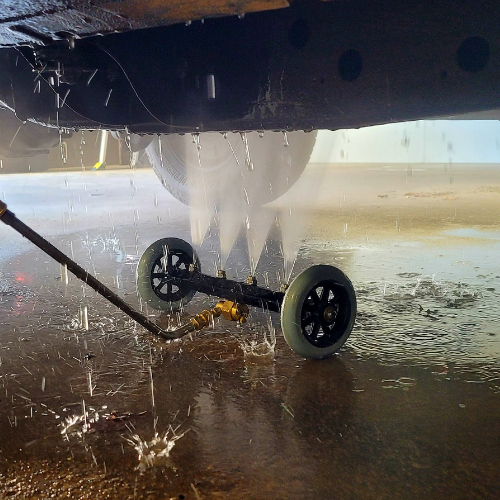
- Get underneath the car. Salt collects in wheel wells, rocker panels, and the undercarriage, none of which are coated. That is where winter damage starts.
- Pick your day. Wash above freezing and dry the car completely, including door jambs, seals and locks.
- Do not skip February. The month owners skip most carries the heaviest salt load.
If outdoor hand washing is off the table, a rinseless wash in a heated garage is a legitimate substitute. Our Quick Wash service, available to coating clients starting at $59, exists for this reason.
A Maintenance Wash and a Decontamination Are Not the Same Service
This distinction costs people their coating performance, and almost nobody explains it. A wash removes what sits on the surface: dust, road film, pollen, bug residue. It does not remove what has bonded to it. Iron particles from brake dust embed into the finish, hard water leaves mineral deposits, industrial fallout works its way in. None of that comes off with soap and a mitt.
The tell is simple. If you have just washed the car properly and it still will not bead, the problem is not frequency. The surface needs a chemical decontamination, and possibly an iron remover and clay treatment, to strip the bonded layer off. That belongs on the calendar once or twice a year, and our Seasonal Maintenance service starts at $149. If the finish underneath has also picked up swirls, that is a separate conversation about paint correction.
How Your Wash Habits Affect Your Coating Guarantee
Professional coating coverage is conditional. It is not a promise that the coating will last regardless of what happens to it, and reading the terms after a problem appears is too late.
At Final Approach Detailing, the F.A.D. Performance Guarantee is tied directly to maintenance. Our advanced 3- to 5-year coating is covered up to 5 years with the annual maintenance package and 3 years without it. Our top-tier 5- to 7+ year coating is covered up to the lifetime of the vehicle with that package. Annual Maintenance starts at $249 and is the level required to keep the guarantee in force.
Your wash schedule is not just about how the car looks this weekend. It is part of the coverage you paid for. Keep your service records.
Drying Is the Step That Decides Whether Your Coating Keeps Beading
Most guides list drying as one tip among seven. In our experience, it is the step that separates a coating still performing at year four from one that looks tired at year two.
When water evaporates off a panel instead of being removed, the minerals in it stay behind as a spot. Left in the sun, those deposits can etch into the coating, and etching does not wash off. It has to be polished out. More on this in our piece on water spots on a ceramic coating.
- Finish with a free-flowing rinse so water sheets off rather than beading into hundreds of separate droplets
- Use forced air first to clear mirrors, badges, trim gaps and lug holes
- Follow with a large, high GSM microfiber towel, patting rather than dragging
- Never air dry in direct sun
What a Safe At-Home Wash Looks Like
Method matters as much as frequency. A coated car washed badly every week looks worse than one washed carefully every three weeks.
- Pre-rinse or foam first so loose grit is off the paint before anything touches it. If you use a pressure washer, read our guidance on pressure washing a ceramic coated car first.
- Use the two bucket method with grit guards, one bucket for soap and one for the mitt
- Use a pH-neutral car shampoo. Dish soap and degreasers shorten a coating's life
- Work top down, saving wheels and lower panels for last with a separate mitt
- Work in the shade on cool panels, never on hot paint
If that sounds like more of a Saturday than you want to spend, our exterior detailing packages handle the same process in our controlled indoor shop in Okemos.
Automatic Car Washes and Ceramic Coatings
Brush and cloth tunnel washes are the fastest way to undo a coating. The equipment drags grit from the car ahead of you across your finish, and the presoaks strip protection over repeated visits. Coated or not, a tunnel wash is one of the detailing habits that damage paint most reliably.
Touchless washes are different. They are chemically harsh, and weekly use will dull a coating's slickness over time. But in February, a touchless rinse that removes salt beats leaving the salt on the car another month. Use it as a winter stopgap, not a routine.
When Washing More Often Is Not the Answer
Sometimes a tighter schedule will not help.
- The car will not bead after a correct wash. That is a decontamination issue or a coating at the end of its life. Washing it twice as often changes nothing.
- It is a garage-kept weekend car. Monthly is enough. Paying for weekly service on a vehicle that sees 2,000 miles a year is money spent on nothing.
- The maintenance commitment is not realistic. If you know you will not keep up with it, our entry-level 12+ month coating starting at $600 is a better fit than a $2,000 package whose value depends on care you will not give it. We would rather sell the right service than the expensive one.
Signs It Is Time Before the Calendar Says So
- Water sheets flat across the panel instead of beading up
- The surface feels rough or gritty after a wash instead of slick
- Dull patches, hazing, or visible rings where water dried
- Bird droppings, tree sap, or bug residue, which are acidic and should come off within a day or two rather than on wash day
- A visible white salt film across the lower half of the car
Keep the Coating You Paid For Performing As It Did on Day One
Final Approach Detailing has been protecting vehicles in Okemos since 2019. Our team is IDA Skills Validated and IDA Certified, with certification as a ceramic coating installer and industry trainer, and we have been a CARFAX Top Rated Service Center from 2021 through 2024. Every coating we install is reported to CARFAX.
Whether you need a maintenance service to keep your F.A.D. Performance Guarantee in force, a decontamination after salt season, or a coating in the first place, we work by appointment. Call (517) 399-3231 or request a free quote, and we will build a plan around how you actually drive.
Frequently Asked Questions
How long after a ceramic coating can you wash your car?
It depends on the product applied, so use the cure time your installer gives you rather than a general figure. Until that window closes, avoid contact washing. We give every client their specific cure time at handoff.
Can you wash a ceramic coated car too often?
Not with correct technique. Weekly washing with a pH-neutral shampoo and the two-bucket method will not wear a coating out. What damages a coating is method, not frequency: harsh chemicals, abrasive sponges, dirty mitts, and tunnel washes.
Can I take a ceramic coated car through an automatic car wash?
Avoid brush and cloth tunnels entirely. A touchless wash is acceptable as an occasional winter stopgap, though weekly use dulls slickness over time.
What soap should I use on a ceramic coated car?
A pH-neutral or pH-balanced car shampoo. Skip dish soap, degreasers, and anything sold as a wax-stripping wash. If beading has weakened, an SiO2 booster spray applied after drying restores some water repellency between services.
Do you offer maintenance washes for ceramic coated cars near Lansing?
Yes. Quick Wash starts at $59 for our coating clients, Seasonal Maintenance at $149, and Annual Maintenance at $249. We work by appointment from our Okemos shop and serve clients throughout Lansing, MI, and the surrounding communities.